
Introduction
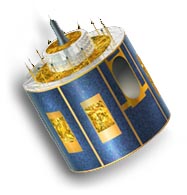
Meteosat Second Generation is operated by EUMETSAT and provides almost continuous images to meteorologists and researchers in Europe and around the world. It incorporates significant enhancements in frequency and resolution to the previous generation of Meteosat. MSG measures in 12 spectral channels (compared to only 3 on the previous Meteosat) and records data in a 15 minute cycle (30 minutes on the previous Meteosat). The resolution of the high-resolution visible light channel measures
1 km at the sub-satellite point (compared to 2.5 km on the previous Meteosat).
The first Meteosat Second Generation satellite, MSG-1, came into operational service on 29th January 2004 and was renamed Meteosat-8. MSG-1 has a nominal lifetime of seven years. MSG-2 was launched on 21st December 2005 and future MSG units are planned.
The MSG payload also contains the Geostationary Earth Radiation Budget (GERB) instrument which provides important data for climate research. Data from the GERB instrument is now available at the BADC.
A humanitarian Search and Rescue transponder that relays distress signals from ships, aircraft and others in need of rescue is also mounted on the MSG platform.
Access Restrictions
Full Resolution Met Office Images and LRIT data
Access to these data is restricted to UK academic users who have applied for and been granted access. Apply for access.
Non-UK based users should contact the Meteorological Office in their own country to obtain the data - as each country (Europe at least) has its own agreement with EUMETSAT.
Lower resolution EUMETSAT web images
These are publicly available - no registration required.
Data availability
There are three types of MSG data available at the BADC
Full Resolution Met Office Images
MSG images and products from the Met Office are now archived at the BADC and are available to registered UK academic users. This includes visible, infra-red, water vapour, High Resolution Visible (HRV) images and the derived cloud top height, cloud top temperature, fog, snow detection, and volcanic ash products. These images are available for a range of geographical areas. Images are available from March 2005 onwards at a frequency of 15 minutes (some are hourly) and are at least 24 hours old. A table of the available products and coverage gives links to the appropriate archive directories. Further details of the images are available here. Images are provided on best-effort basis and it is not possible to fill any gaps.
For specific measurement campaigns these images may be available in near-real time. Each project is considered separately - please contact the BADC.
Full resolution images archive
products and coverage table
All Full resolution MSG images in our archive are subject to EUMETSAT/Met Office copyright.
It is a condition of data use that all images used should include EUMETSAT's copyright
credit displaying the text "Copyright EUMETSAT/Met Office" on each image.
|
Lower resolution EUMETSAT web images
Whilst recent images are publicly available via EUMETSAT's own website, they are only accessible for 3 days after measurement. A longer term store of these images has been created at the BADC to enable easy access to older images - these are also publicly available. The images are taken hourly and coverage includes most of Europe and part of North Africa. Four channels are available: visible(0.6nm), IR(3.9nm), IR(10.6nm) and water vapour(6.2nm).
Lower resolution web images archive
|
These lower resolution images should be credited "Copyright EUMETSAT" on each image.
|
LRIT data
Full resolution LRIT (Low Rate Information Transmission) data - comprising of 5 spectral channels every 30 minutes -is available from the BADC to UK academics subject to certain access conditions. This data is in EUMETSAT's own data format.
LRIT data archive
Links to further information and references
Citation
EUMETSAT, Second Generation (MSG), [Internet]. NCAS British Atmospheric Data Centre, 2006-, Date of citation. Available from http://badc.nerc.ac.uk/view/badc.nerc.ac.uk__ATOM__dataent_msg
Who to contact
- For queries about these pages and difficulties in data retrieval, please contact the BADC Support Line.
- About Meteosat operations: the EUMETSAT organisation at ops@eumetsat.de.