
Dataset Collection
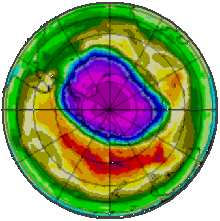
Total Ozone Mapping Spectrometer (TOMS) and Ozone Monitoring Instrument (OMI): Global Daily Gridded Averaged of Total Column Ozone, Aerosol and Reflectivity Images
Abstract
The Total Ozone Mapping Spectrometer (TOMS) is an instrument built and operated by the National Aeronautics and Space Administration (NASA). The instrument uses backscattered ultraviolet radiance to infer total column ozone measurements. The data consists of daily gridded averages of total ozone covering the entire globe. The original Nimbus-7 TOMS operated from November 1978 until May 1993. Meteor-3 TOMS was launched in August 1991 and operated until December 1994.
After a gap of one and a half years, two new TOMS instruments began operation in 1996: Earth-Probe TOMS was launched on 2nd July 1996 and started to produce data on 25th July. ADEOS TOMS was launched on 17th August 1996 and started producing data on 11th September. The satellites were originally placed in different orbits, giving complete global coverage with the ADEOS data, while Earth-Probe had complete coverage at the poles with an increased ability to measure UV-absorbing aerosols in the troposphere. ADEOS failed in June 1997 and Earth-Probe was subsequently placed in a higher orbit to give global coverage.
On Saturday, december 2, 2006, contact with Earth Probe was lost. There has been no communication with the spacecraft since. The spacecraft is intact and Earth-oriented which mean that it is still operational and maintaining attitude. On Wednesday December 6, the spacecraft was commanded to go to SAFE mode, in which it points at the sun, which will maintain power indefinitely. The spacecraft is now sun-pointing, indicating that the receiver and processor are working. Earth Probe has been operating on its backup transmitter since 1998 when the primary failed. The operations team tried to switching to the zenith antenna in hopes that the problem was the nadir antenna, but still no signal was received. This likely means that the transmitter has failed. At this point the probability of recovering looks poor but the Earth Probe team is still trying.
Before contact was lost with Earth Probe, there were calibration problems with EP TOMS and so in the view of the good performance of the Ozone Monitoring Instrument (OMI) on the AURA spacecraft, OMI data of ozone are now available for the entire OMI mission beginning with August 17, 2004 through the most recent data.
In addition to ozone data, OMI data for aerosol and reflectivity are available from August 17, 2004; images are available from here.
Details
Related Documents
Temporal Range
1978-01-11T00:00:00
Ongoing
Geographic Extent
90.0000° |
||
-180.0000° |
180.0000° |
|
-90.0000° |