
Introduction
The Earth Radiation Budget Experiment is designed around three Earth-orbiting satellites: the NASA Earth Radiation Budget Satellite (ERBS), and two NOAA satellites. The data from these satellites is being used to study the radiation budget, which represents the balance between incoming energy from the Sun and outgoing thermal (longwave) and reflected (shortwave) energy from the Earth. The Earth's radiation budget is the primary indicator of global climate change. The absorbed shortwave radiation (incident minus reflected) fuels the earth's climate and biosphere systems. The longwave radiation represents the exhaust heat emitted to space. It can be used to estimate the insulating effect of the atmosphere (the greenhouse effect). It is also a useful indicator of cloud amount and activity. Consequently the ERBE has helped scientists worldwide better understand how clouds and aerosols, as well as some chemical compounds in the atmosphere (greenhouse gases), affect the Earth's daily and long-term weather (the Earth's climate). In addition, the ERBE data has helped scientists better understand how the amount of energy emitted by the Earth varies from day to night. These diurnal changes are also very important aspects of our daily weather and climate.
In the 1970's, NASA recognised the importance of the radiation budget and its effects on the Earth's climate. Langley Research Centre was charged with developing a new generation of instrumentation to make accurate regional and global measurements of the components of the radiation budget. The Goddard Space Flight Centre built the Earth Radiation Budget Satellite (ERBS) on which the
first ERBE instruments were launched by the Space Shuttle Challenger in 1984. ERBE instruments were also launched on two National Oceanic and Atmospheric Administration (NOAA) weather monitoring satellites; NOAA 9 and NOAA 10, in 1984 and 1986.
The ERBE instrument aboard ERBS, launched from the Space Shuttle Challenger in October 1984 (STS-41G), had the main aim of providing accurate measurements of incoming solar energy and shortwave and longwave radiation reflected or emitted from the Earth back into space. The other goals of the Earth Radiation Budget
Experiment (ERBE) are:
- to understand the radiation balance between the Sun, Earth, atmosphere and space which drives our weather and climate system.
- to establish an accurate, long-term baseline dataset for studying climate system changes.
All of the initial goals were met, and the ERBE instrument continues to provide valuable data. Earth Radiation Budget Experiment (ERBE) data are fundamental to the development of realistic climate models and for studying natural and anthropogenic perturbations of the climate system.
This CD-ROM contains data and colour images from scanning radiometers on the three ERBE satellites and for combined satellite cases. The CD-ROM is written using the ISO-9660 standard. Monthly average values are included for the time periods during which the scanners were operational.
Data Access
The ERBE data are held on a CD-ROM at the BADC and are made available for browsing purposes. If you want to use the data in earnest you should order a copy of the CD from the contact address below. The CD-ROM holds a few directories, including the ERBE data.
Data availability and file format
This CD-ROM contains data and colour images from scanning radiometers on the three ERBE satellites and for combined satellite cases.
Documentation and Links to further information and references
Readme documentation can be found on the ERBE CD-ROM. More extensive documentation is available on the ERBE datasets web page, and includes the following topics:
- Earth Radiation Budget Experiment (ERBE) Langley DAAC Project Document
- Earth Radiation Budget Experiment (ERBE) Regional, Zonal, and Global Averages (S-4) Output Product Langley DAAC Data Set Document
- Earth Radiation Budget Experiment (ERBE) Regional, Zonal, and Global Averages (S-4N) Output Product Langley DAAC Data Set Document
- Earth Radiation Budget Experiment (ERBE) Regional, Zonal, and Global Averages (S-4G) Output Product Langley DAAC Data Set Document
- Earth Radiation Budget Experiment (ERBE) Regional, Zonal, and Global Averages (S-4GN) Output Product Langley DAAC Data Set Document
- Earth Radiation Budget Experiment (ERBE) for Monthly Medium-Wide Data Tape (MWDT) (S-7) Langley DAAC Data Set Document
- Earth Radiation Budget Experiment (ERBE) S-8 Processed Archival Tape (PAT) Data in Native (NAT) Format Langley DAAC Data Set Document
- Earth Radiation Budget Experiment (ERBE) Earth Radiant Fluxes and Albedo for Month (Scanner) (S-9)/Earth Radiant Fluxes and Albedo for Month (Nonscanner) (S-10) Langley DAAC Data Set Document
- Earth Radiation Budget Experiment (ERBE) Earth Radiant Fluxes and Albedo for Month Nonscanner (S-10N) Langley DAAC Data Set Document
- Earth Radiation Budget Experiment (ERBE) Solar Monitor Irradiance Langley DAAC Data Set Document
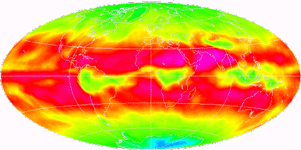
A sample image is available from the ERBE total solar irradiance data, on the ERBE datasets web site.
A list of references has been extracted from the ERBE web pages.
You may visit the ERBE datasets information page, which has links to the ERBE CD-ROM information page and the NASA ERBE home page.
Citation
National Aeronautics and Space Administration. [Barkstrom, B.R.; Minnis, P.] Earth Radiation Budget Experiment (ERBE), [Internet]. Langley Distributed Active Archive Center, 1990, Date of citation. Available from http://badc.nerc.ac.uk/view/badc.nerc.ac.uk__ATOM__dataent_ERBE.